A look at some exciting hardware
By Layne Simpson
While the name Weatherby has long been synonymous with top-quality centerfire rifles chambered for flat-shooting, hard-hitting cartridges, there have been a number of different shotguns along the way as well.
 The author (left) and Ed Weatherby found the Athena D'Italia over-unders to be quite effective on bobwhites. |
Roy Weatherby started his custom rifle business in 1945 in an empty garage behind his home but it was not until much later that he started selling shotguns. His first one, an over-under double called the Regency, was built by the Italian firm of Zoli and introduced in 1970. Seven years later it was joined by the less expensive Olympian, which was manufactured in Japan by Nikko Kodensha. Then in 1980 all over-under production was shifted to the Japanese firm of SKB where the Athena and Orion were built until 2007.
The manufacture of Weatherby over-unders has now come full circle and they are once again being built by an Italian firm. This time it is Fausti Stefano Arms, a company that, like Weatherby, was founded during the 1940s. Even though the manufacturer of Weatherby over-unders has changed, the Athena and Orion names have been retained but with the addition of "D'Italia" to differentiate them from the guns built by SKB.
Like the old gun, the new over-under has a boxlock action in two grades, the Athena with sideplates and the less expensive Orion without them. Otherwise, the same action is used in both and it differs considerably from the SKB action.
An ejector gun, the Weatherby D'Italia in all its variations is available in 12 and 20 gauge while the 28 gauge is presently offered only in the Orion II and Athena IV grades. I hunted Georgia bobwhites with the 28-gauge Athena IV and believe me when I say it is a sweet little gun.
It is also quite sturdy. Taking a peek inside the action, you'll see the barrels hinge on replaceable trunnions while primary breech lockup is accomplished by a wide Browning-style bolt that extends from the lower edge of the standing breech to engage recesses at the bottom of the monobloc.
A disadvantage to this type of lockup is that it sometimes results in a rather deep receiver and the old Browning Superposed is a good example. Not so with the Weatherby receiver as its depth is kept relatively shallow by reducing the length of the locking recess feet extending from the bottom of the monobloc.
The axial force that tries to push the barrels forward and away from the receiver when a double-barrel gun is fired is further resisted in the D'Italia action in two ways--by a pair of side lugs inside the receiver that engage recesses in the sides of the monobloc and by allowing the locking recess feet of the monobloc to extend into recesses in the floor of the receiver. The old Browning Superposed action is famous for its ability to withstand thousands of firings without shooting loose and if anything, the Weatherby action is even stronger.
While the new Weatherby is not a genuine round-action gun, it feels a lot like one due to the absence of sharp edges along the bottom of its receiver. Add to this its shallow depth and you have an extremely comfortable gun to carry with one hand. The 20 gauge action measures 2.250 inches tall and 1.410 inches thick for a circumference of 61„2 inches, making it trim enough through its midsection to allow the ends of my thumb and finger to overlap when I wrap my hand around it.
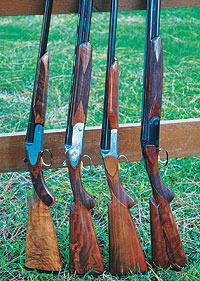 From left to right: Athena D'Italia side-by-side, Athena D'Italia over-under, Orion D'Italia side-by-side, Orion D'Italia over-under. |
In comparison, my 20 gauge Browning Superposed measures 2.350 inches tall and 1.445 inches thick for a circumference of almost seven inches, while my SKB-built Athena measures 67„8 inches in girth.
Weatherby is not the first to house the barrel selector tab in the automatic safety slide but they are first to get it right. On other guns the selector operates backward from the way it should and when the tab is all the way to the left, the bottom barrel (more open choke) fires first. Anytime I have worn gloves while hunting with one of those guns I invariably brushed the tab to the right as I operated the top lever of the gun with my thumb and ended up shooting the tighter choke first on my next shot.
Okay, so I could reverse the chokes on a screw-choke gun and shoot the top barrel first, but that's not the way an over-under is supposed to be shot. Or at least it is not the way I am accustomed to shooting one. Thanks to those three lovely Fausti sisters over in Italy who own and operate the company, the barrel selector on the Weatherby gun operates just the opposite and the lower barrel shoots first when the tab is to the right; you have to push it to the left in order to shoot the top barrel first. The single trigger is recoil reset with the one on the 20 gauge gun I shot a few rounds of skeet with pulling 43„4 pounds with about a quarter-pound variation between pulls.
Barrel length options for field guns are 26 and 28 inches and ventilated side ribs help dissipate heat during a fast round of skeet or a really good dove shoot. The non-tapered, ventilated top rib is .235 inch wide on 20 gauge barrels and .270-inch in 12 gauge, both serrated on top for glare reduction. A single brass-colored bead up front measures 0.140 inch in diameter.
They did an excellent job of striking the barrels at the factory and my eyes could detect not a single surface wave or ripple. The 20 gauge barrels measure .870 inch in diameter at the front of the monobloc and taper to .775 inch at their muzzles; the 12 gauge barrels measure .980 inch out back and .875 inch up front.
The barrels of the guns I checked had chrome-lined bores and lengthened forcing cones and were lightly overbored at .545 inch for the 28 gauge, .630 inch for the 20 gauge and .735 inch for the 12 gauge. Each gun comes with Improved Cylinder, Modified and Full chokes but Skeet and Sporting Clays are also available.
I measured choke constriction in the 20-gauge gun and came up with .006 inch for the one marked Skeet and .018 inch for the IC choke which is a bit closer to what the Weatherby spec sheet describes as Sporting Clays I and Modified.
All stocks are walnut and have Prince of Wales grips, a style that was first popularized among American hunters by Browning's A5 and Superposed shotguns. Checkering is 20 lines per inch and quite ni
cely executed with no runovers and not a single diamond left begging to be pointed up. The sporting clays gun has a schnable-style forearm but I am happy to report that field guns have forearms of a more conventional shape. Both styles are held in place by a Deeley-style latch.
It is impossible to make one shotgun stock fit everyone but the D'Italia stock represents a good compromise for a very large percentage of shooters; pull length, drop at comb and drop at heel measure 14, 11„2 and 21„4 inches, respectively. All buttstocks wear a thin rubber pad. My postal scale says the 20-gauge Athena with 26 inch barrels weighs 61„4 pounds or half a pound less than my old SKB-built Athena with 28 inch barrels. The new 12 gauge gun weighs 71„4 pounds.
 The new SA-08 autoloader is available in 12 and 20 gauge. |
As it goes with any shotgun, the higher you climb in grade the fancier the wood and the more extensive the metal engraving. The Orion is available in grades I, II and III with suggested retail prices ranging from $1499 to $1975. The Athena with its sideplated receiver is available in grades III, IV and V at prices ranging from $2299 to $3599.
You can also get a multiple barrel set with barrels in 20 and 28. The 12 gauge Sporting Clays is available with 28, 30 or 32 inch barrels and sells for $2299. Custom-fitted hard cases are available for all models.
The PA-08 Pump Gun
The PA-08 is the first pump gun to be offered by Weatherby since the Model 92 was discontinued back in 1989. Built in Turkey and available only in 12 gauge, it has a chrome-lined, backbored barrel with ventilated rib and its trigger assembly is easily removed for cleaning. Depending on the model variation, barrel length options are 18, 24, 26 and 28 inches, all with three screw-in chokes.
Those who also hunt deer and turkey with a shotgun will appreciate that its grooved receiver makes the mounting of a scope or electronic sight quite easy. The variations are Field with walnut stock, Home Defense with 18-inch barrel and just for turkey hunters, the Strutter replete with camo finish and Knoxx recoil-reducing stock. Suggested retail price is $350.
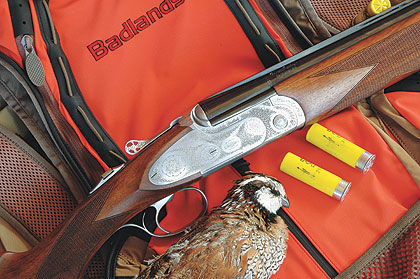 The sideplates of the Athena D'Italia IV are nicely engraved. |
The SA-08 Autoloader
Roy Weatherby introduced his first autoloading shotgun, the Centurion, in 1972 and it was built in Japan by two companies, KTG and Nikko. In 1982 the name of the gun was changed to Model 82 and after its discontinuance a few years later, Weatherby's autoloader stable would remain empty until the SAS was introduced in 1999. That gun has now been replaced by the Turkish-built PA-08.
A gas-operated gun, it was designed to utilize a pair of gas valve sleeves that fit around the magazine tube; one sleeve is used with light loads while the other is used with heavy loads. If this seems like moving backward in shotgun design it is but for a reason--Weatherby did it in order to keep the price of the gun as low as possible.
Actually, switching gas sleeves is no more trouble than removing the forearm, something owners of Browning Auto-5s are accustomed to doing. Vent-ribbed barrel options are 26 and 28 inches and IC and Mod chokes are included. Two SA-08 variations will initially be offered, Field with walnut stock in 12 or 20 gauge and the 20-gauge Youth which is the same gun with a 121„2 inch length of pull. The 20-gauge Field I have been shooting weighs exactly six pounds on my postal scale. The price is $699 but I've seen them advertised for considerably less.
Other News From Weatherby
The Orion D'Italia Side-By-Side
The side-by-side doubles introduced by Weatherby a few years back are also built by Fausti with a less expensive version called the Orion D'Italia unveiled during late 2007. Available in 12 and 20 gauge, it mainly differs from the Athena D'Italia by the lack of sideplates and it has a nonselective single trigger (always fires the right barrel first).
The fact that the Orion and Athena names are now shared by Weatherby's over-under and side-by-side guns is a bit confusing but it is something we will have to learn to live with. Just remember that regardless of whether a gun's barrels are oriented north-south or east-west, if it has sideplates it is an Athena and if it does not it is an Orion. A nice little gun for less than two grand.
Torture Test In Argentina
When kept clean and in proper working order, modern autoloading shotguns can be quite reliable but I recently found out how good one can be when it is subjected to more than a normal amount of neglect. I was shooting doves in Argentina where most outfitters have a knowledgeable member on the staff who is responsible for cleaning and lubricating everyone's guns after each day in the field. It's a chore I'd just as soon handle myself, especially if the gun belongs to me, but most of the people there take great pride in their work and I have found it best to go with the flow rather than risk insulting someone who means well.
At any rate, several weeks after filing my initial report on Weatherby's new shotguns, I found myself on the edge of a vast cornfield located quite a ways northwest of Buenos Aires with thousands upon thousands of doves flying all about. So I started doing my best to thin out the population a bit with a Weatherby SA-08 in 20 gauge. I was shooting locally-manufactured shells loaded with 7/8 oz. of No. 8s and while their downrange performance was as good as anything I have ever shot, the powder they were loaded with left gobs of propellant residue behind. This along with the great number of rounds fired is the primary reason why Argentine outfitters insist that semiautomatic shotguns be thoroughly cleaned at the end of the day. And that's exactly what I thought was taking place with my gun. A number of subjects were covered over dinner each night, including how well our guns worked; each and every night I was proud to cheerfully report that I had yet to experience a single malfunction.
Then it happened. About halfway through the fourth morning of shooting, I experienced a misfire from my SA-08. A shell chambered, but the firing pin did not deliver a heavy enough blow to its primer to light the fire. Truth of the matter is, I really was not all that disappointed since at that point I had fired 136 boxes of shells in the gun. Anyway you cut it, one hiccup in 3400 rounds is not exactly shabby performance. Before that morning was over I had experienced a second misfire and the bolt refused to completely close on another chambered round.
Back at the lodge, we took the gun apart and found the interior of the action, including inside the bol
t and round the firing pin, to be coated with a tremendous buildup of gunk and debris. That the gun had managed to function at all was absolutely remarkable and says a lot for the fellows who built it.
Later, a bit of investigative work revealed that daily cleaning by the camp gun guy had consisted of running a bore snake through the barrel and wiping carbon from the magazine tube. Not once had he cleaned the action. It was not intentional on the fellow's part--he was relatively new on the staff and had not received instructions on cleaning the action of an autoloader. At any rate, after receiving a proper cleaning, the SA-08 once again sang its happy song without missing a single beat during the remainder of the trip.