Searching for that unrivaled scattergun proves to be a challenge.
By Layne Simpson
When it comes to hitting moving targets with a shotgun, I do not rank myself anywhere close to the best in any particular aspect of the game. Still, those with whom I regularly shoot have gone so far as to say that I am really not all that bad at any of them. And they were sober and not a single one owed me money when saying it.
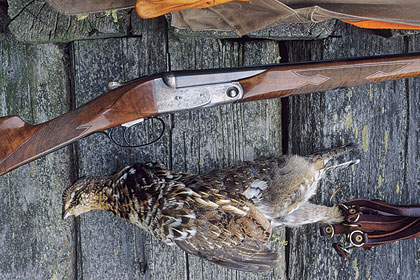 This lightweight double in 28-gauge is the closest the author has come in his search for the perfect ruffed grouse gun. |
I don't shoot as many clay targets nowadays as I once did but I can still pick up about any gun and break better than 95 percent of birds thrown in skeet or trap. Not good enough to be a great competitor in either of those games, but not too shabby for a bird hunter shooting a bird gun, either.
Down Argentina way, where doves absolutely darken the sky and the shots are often quite easy, I usually shoot upwards of 60 percent with a 20-gauge gas gun and on my better days I have approached 80 doves for every four boxes of shells. Not as good as some are capable of but good enough to keep me going back.
I think I have managed to figure out other birds as well. On a recent and rather lengthy hunt in South Dakota, I missed very few pheasants on the first shot and while I had to squeeze the second trigger on a few, not a single one flew away crippled.
Then we have the matter of quail. I grew up hunting bobwhites and while there are people who find them difficult to hit, I am fortunate to not be one of them. Other birds? I did not start hunting sharptailed grouse and Hungarian partridge until later in life but I managed to quickly get their number as well. As for chukar, I find them more difficult to get to than to hit. So you might say I am a fair-to-middling shot on flushing birds — with one exception.
On my very best day I am one of the worst shots on ruffed grouse you will ever witness, especially during early season before the trees have shed their leaves. I am good at hearing them flush but I am no good at seeing them fly. And of course, in order to have any chance at all of hitting a bird you must first see it. But even when I do see the bird, I more often cut twigs and leaves than feathers. I love that darned bird but it has my number and shows it at every opportunity. Here is an example.
It happened during a hunt with a couple of friends who own a farm on Michigan's Upper Peninsula. On the previous day I had pulled off the impossible (for me, anyhow) of killing two birds on consecutive flushes with one shot each. Believe me when I say I was feeling pretty darned cocky. Who said grouse are tough?
 This hunter's perfect grouse gun is a 20-gauge Remington Model 1100. |
All sorts of images raced through my dreams that night, like a front page headline in the Davidson Gazette proclaiming, "Southern boy kills a pair of partridges with only two shots." And I kept seeing this granite monument on the city square with the likenesses of me and my trusty grouse carved into its shiny surface. Then I made the mistake of hunting another day.
We were walking along an old abandoned logging trail when up ahead we spotted a grouse, not perched in a tree as the books say they often do, but standing flat-footed on the ground. "Step up and shoot that bird", whispered my host, as I dropped two shells into the chambers of my double. What happened next convinced me beyond doubt that grouse do, in fact, have the upper hand in the scheme of things.
With gun at ready, I moved on in and even though I was in plain sight of my intended target (who by that time had stopped pecking at the ground and was staring intently in my direction), it allowed me to get within about 25 yards before flushing. But rather than flying off into the brush and brambles as it was supposed to do, the bird flew directly away from me, arrow-straight down the open trail.
It was one of those shots we don't even dream about because we know it will never happen in three lifetimes. But on that bright and sunny day it happened to me and I missed with both barrels by a country mile. It couldn't have been me, I thought; someone who can shoot 60 percent on doves can't possibly be that bad a shot on grouse.
Convinced that it had to be the gun, my quest began.
I am closer to the perfect grouse gun today than back when I missed my first grouse, but since I am still missing them on a regular basis I obviously am still not all the way home. I still have a bit to learn about grouse guns so keep in mind that what you are reading now might read differently next week, but at the moment, here is what I think I have figured out.
I have tried heavyweight, medium-weight and lightweight guns and through trial and error have come to the conclusion that I miss less often with a gun weighing around 51„2 pounds, which just happens to be exactly what my 28-gauge AyA weighs.
I don't believe I manage to get that gun on a bird any more quickly than a heavy gun, but I do find it easier to carry with one hand in the parade position while parting brush with the other. And besides, if you are destined to miss regardless, why burden yourself with a heavy gun?
 Here's an unlucky grouse taken by the author on one of his better days. |
I have about decided that when all is said and done, fit is more important in a grouse gun than anything else. Which brings up my fun way of determining whether or not a gun fits me. I head to the skeet field when very few other shooters are there, loop the puller cable through my belt, hold the controller in one hand and the gun in the other. I then go to station eight and pull birds for myself from the low house.
After breaking half a dozen or so from the pad I take a long step closer to the trap house and fire another six. I continue moving forward and shooting targets and if I make it more than halfway to the trap house without missing a lot of birds with a particular gun, it fits me. I then take that gun hunting and miss more grouse.
As for shotshell size, I have tried the 28, 20, 16 and 12 and a
s best as I can tell, I miss as often with one as the other. Even so, if all the dope and data on the perfect partridge cartridge were fed into a computer, the machine would probably groan loudly, belch a huge cloud of smoke and tell us that the ability to shoot a shotgun is more important than its bore size.
I love the 20-gauge, hope to never be without a gun in 16-gauge and use the 28-gauge for most of my upland hunting, but I'll have to admit the 12-gauge has a lot of things going for it. Low-recoil loads with light shot charges that duplicate the performance of the smaller gauges are available and there are 12-gauge guns that weigh less than some 20-gauge guns. Still, I prefer the way a small-gauge gun feels and if you are destined to miss grouse regardless, why hunt with a gun that you don't like?
I hear one of the arms companies is developing a grouse gun that will have some type of range-finding, feather-seeking, angle-calculating, laser guidance system capable of automatically pointing the muzzle in just the right direction to guide the shot charge around a tree rather than into it and to that point in space where a grouse is about to be rather than where it used to be.
I mailed my check yesterday and since I seldom hunt alone, I paid extra for the model with a tiny LCD screen that gives me a different alibi for each miss.