The name does not say it all!
By James B. Spencer
Years ago, when I first heard of this breed, my initial thought was that this is the only breed whose name is also its résumé. After saying that the breed is from Nova Scotia and that it tolls and retrieves ducks, what else is there to say?
Plenty!
The toller comes very close to being the perfect canine companion for today's all-around marshes and meadows slogger, the person who hunts every bird the game laws in his area allow. The toller can rip through nasty cover with flashy style and tireless endurance, flushing and retrieving upland birds. He can sit quietly beside a duck or goose blind, and he can break ice when necessary to retrieve shot birds.
He can sit quietly in a boat or even a canoe, taking up very little space, exiting and entering gracefully to retrieve shot birds. He can sneak along at heel when the boss decides to jump-shoot waterfowl. Wherever he hunts, he can mark and remember falls with uncanny accuracy.
Oh, yes, I almost forgot: He can also toll ducks (and geese). See the second sidebar for information on tolling
Then, too, as the name indicates, the toller hails from Nova Scotia. However, over the years he has become an international star, having been exported not only to USA, but also to various other countries around the world. And wherever he has gone, he seems to be performing quite well, thank you.
Clearly, the name, Nova Scotia Duck Tolling Retriever, is not the breed's complete résumé. Not even close. In fact, it's a masterpiece of misleadingly modest understatement.
To help me present this multi-talented breed properly, I interviewed four long-time toller experts: Katie Dugger, Sue Dorscheid, Alison Strang, and Glen White. See the first sidebar for background information on these knowledgeable folks.
Physically
When you first see a toller, you might think it's a miniature golden retriever, except for the few flashy white points, perhaps on the chest, feet, and tail. A white tip to the tail is highly prized by those who use these dogs for tolling, because when swished around it attracts the attention of rafted ducks.
Tollers stand about 17 inches to 21 inches and weigh 35 to 50 pounds, a nice size for today's hunting conditions. The double coat has a harsh water-repellent outercoat overlaying a dense wooly undercoat. The color can be anything from light gold to coppery red.
The toller is a bouncy, high-energy animal with amazing stamina. These traits make him a great upland game finder/flusher/retriever. In style, the breed rivals the English springer. In endurance, it excels most sporting breeds.
Temperament
Never has the adage, you can't judge a book by its cover, been more true than in the case of the toller. He may look like a miniature golden, but inside, that is, under the hood, the two breeds are quite distinct. And this reflects poorly on neither breed. Different people developed the two breeds under different circumstances and for different purposes.
The golden was developed on the British Isles by the landed gentry, who had huge estates on which to hunt. These aristocrats also had hired gamekeepers to manage their estates and train their dogs. Not surprisingly, the golden is a "trainer's dog," that is, a breed that responds well to the repetitive drilling that extensive formal training requires.
The toller was developed in rugged Nova Scotia by early Scottish immigrants, a hardy people who were scratching out a difficult living, struggling to survive in a strange new land. They developed the toller as a "hunter's dog," that is, a breed that does most of what the owner wants done naturally, with very little formal training beyond basic obedience.
To this day, the toller is more a hunter's dog than a trainer's dog. He does most of what the generalist hunter needs quite naturally. He has an almost insane desire to retrieve and will do it over and over and over without appearing to tire. This seemingly inexhaustible energy was necessary for tolling ducks all day back before bag limits. Happily, this same endurance comes in handy today when hunting to the gun in the uplands.
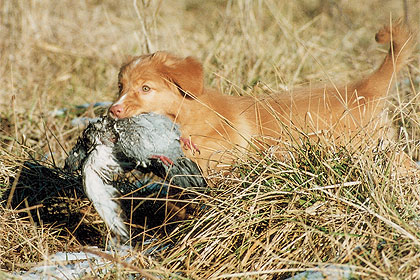 The toller was bred to do most of what the owner wants done naturally, with very little formal training. |
However, the toller tends to resist the repetitive drilling required for the success in the advanced blind retrieves encountered in field trials and hunt tests. He especially resists negative methods.
"Tollers respond best to positive training methods," Alison Strang said. "If you push too hard, they can become either cowed or stubborn. In this they're like Chesapeakes, but then I think the two breeds share some common genes."
To succeed in drilling a toller, even within a positive framework, the trainer must be quite clever. He must mix in plenty of marks and fun-dummies to keep the toller from becoming bored -- and "creative" in how he repeats a drill.
Happily, like most hunter's dogs, the toller retains his training quite well, and does not require frequent re-training, as do most trainer's dogs.
"Let me tell you," Sue Dorscheid said with a chuckle, "they retain everything wrong that you accidentally teach them! But seriously, they're very smart and retain their training very well."
Origin
The hardy Scots who developed the toller had no time for record-keeping, so little is known today about what breeds they used to develop the toller. According to the book, The Nova Scotia Duck Tolling Retriever, by Alison Strang and Gail MacMillan, they probably started with (tolling but non-retrieving) Pipers from England, but it's anyone's guess what other breeds they mixed in to produce a breed that both tolls and retrieves waterfowl.
As a Waterfowler
By some serendipitous smile of fortune, the toller seems to have been designed for today's waterfowling conditions.
First off, he is small, fitting nicely n
ot only into confined quarters in a blind or boat, but also into the typical hunter's urban or suburban lifestyle. When not hunting, he can be a charming pet around the house or apartment.
Second, he doesn't seem to know that he's so small. A tough little guy, he'll take on even the largest crippled goose and get it back to the boss somehow.
"Our old guy, Tigger," Katie Dugger said, "used to 'tackle' a crippled goose, wrestle it into submission, carry/drag it back to us, deliver to hand, and then, if another goose was out there, dash off to do it all again. Tigger weighed only 44 pounds, but he would hit a crippled goose like a linebacker bowling over a running back."
Third, his shake-dry double coat protects him from cold weather and even from cold water. When necessary, he'll break ice repeatedly to retrieve downed waterfowl.
Fourth, he marks and remembers falls as well as any retriever breed and better than most. If the boss can scratch a bird down, the toller can usually find it without any help from anyone.
 When swished around, a toller's white tip on its tail attracts the attention of rafted ducks. |
Fifth, he can be trained to do basic blind retrieves by even the most average owner. It might take a pro or experienced amateur to teach him the highly complex blinds set up in major field trial stakes, but Joe Average can train him in basic blinds, which is all a hunter usually needs. Thus, the toller is a great conservationist, in that he marks extremely well and handles to blind retrieves well enough for most practical purposes.
Oh, yes, I almost forgot again: He can also toll ducks if the boss so desires.
"I use my tollers for tolling," Glen White said. "I hide and toss a tennis ball or stick along the shoreline for the dog to retrieve. These are play retrieves, not 'commanded' retrieves.
"No matter how close the birds get to shore, the dog must ignore them and retrieve the ball or stick. Tough assignment. Only when I stand up and start shooting is the dog allowed to focus on the birds."
As an Upland Flusher
Since bag limits were imposed (wisely), the toller's tireless energy has no longer been necessary in waterfowling. However, it still helps the breed excel in the uplands.
"We hunt our tollers," Katie Dugger said, "in nasty, forested grouse cover for hours without taking a break. When in good shape, they can go all day."
"Of course," Alison Strang added, "they do not do well in warm weather, but neither does any other breed! You have to watch your dog for over-heating, which is far more serious for dogs than people."
Being strongly attached to the boss, the toller tends to hunt close. If the boss takes a little time during early obedience training to teach him a couple of basic whistle commands -- the Sit-whistle (one long tweeeet) and the Come-whistle (several short tweets) -- he will be able to control his dog nicely in the uplands.
It's not necessary to teach a toller formal quartering. Just let him hunt ahead of you and keep him within gun range with those two whistle commands. As he gains experience, he'll know much better than you where the birds will be, so just tag along behind and shoot the birds he flushes.
"Tollers tend to hunt within gun range naturally," Sue Dorscheid said, "and many seem to quarter naturally, at least in areas where that makes sense, like wide fields of even cover."
Being small and well-protected by the harsh coat, the toller can hunt very heavy cover quite effectively. He does pick up burrs, but not as many as dogs with a softer, longer coat.
Sponsoring Organizations
The toller was recognized by the Canadian Kennel Club (CKC) in 1945, by the United Kennel Club (UKC) in 1987, and by the American Kennel Club (AKC) in 2003.
The breed-sponsoring club in Canada is The Nova Scotia Duck Tolling Retriever Club of Canada, NSDTRC of Canada, whose website is www.toller.ca. The sponsoring club in USA is The Nova Scotia Duck Tolling Retriever Club (USA), NSDTRC (USA), whose website is www.nsdtrc-usa.org. These clubs offer many events, activities, and awards for the toller breed. Their websites are mother-lodes of breed information.
Both clubs sponsor annual "National Specialty" events, which include all forms of toller activities: field, obedience, and show. For information on the next National Specialty of each club, check the websites.
At their National Specialty, NSDTRC of Canada offers an annual award to the top all-around toller at the year's National Specialty, an award with an intriguing title, the "Fair Dinkum" Award.
At their National Specialty, NSDTRC (USA) offers annual awards to each qualifying all-around toller, awards with an almost as intriguing title, the "Rusty Jones" Award.
For the interesting stories behind these awards, go to the two websites.
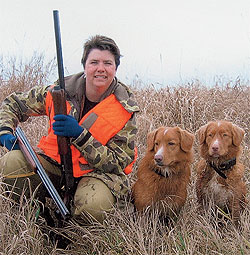 Katie Dugger |
Interviewees
Bruce and Katie Dugger have been active in the breed for 15 years. In addition to hunting both waterfowl and upland gamebirds with their tollers, they participate in conformation, AKC hunting tests, NSDT RC (USA) field tests, and obedience trials. Katie is the current President of NSDTRC (USA). They breed tollers. Before getting into tollers, the Duggers had Labradors for many years.
"Currently," Katie said, "we also have a Cardigan Welsh Corgi, which is a hoot!"
They were first attracted to the toller by its size, energy, and biddability.
"We then lived in central Missouri," Katie said. "where we hunted waterfowl mostly from layout boats, so the toller's small size appealed to us. Then, too, they're very 'sparkly' and fun to live with."
Contact: Katie Dugger, Tinamou Tollers; 3477 NW Countryman Circle, Albany, OR 97321; www.tinamoutollers.com; tinamou@comcast.net.
 Sue Dorscheid |
Sue Dorscheid has been active in the breed for 22 years. In addition to hunting both waterfowl and upland gamebirds with her tollers, she participates in conformation, AKC & UKC hunt tests, NSDTRC (USA) field tests, obedience trials, agility, and rally. She breeds tollers. Sue also has a Labrador.
She was first attracted to the Toller breed by its small size. "I wanted a retriever," she said, "but not a very large one."
Contact: Sue Dorscheid, Springvale Kennels: N7259 Hill Blvd., Rosendale, WI 54974; http://home.centurytel.net/elmo, bigsue@centurytel.net.
Alison Strang has been active in the toller breed for 34 years. She participates in conformation, hunting tests, working certificate tests, and obedience trials. She breeds tollers. In the past, she has also had a Newfoundland.
She was first attracted to the toller by its small size and great versatility.
"Frankly," she said, "we wanted a smaller dog that could swim, play, and stand up to our Newfoundland. But the toller soon took over completely. I also liked the fact that they are from Nova Scotia, where we have spent many memorable summers."
Alison co-authored (with Gail MacMillan) the book, The Nova Scotia Duck Tolling Retriever (Alpine Publications, Inc., ISBN 0-931866-73-1).
Contact: Alison Strang, Westerlea (CKC Permanent Registered); 2456 141 Street, Surrey, BC Canada V4P2E7; www.westerlea.ca; westerlea@show.ca.
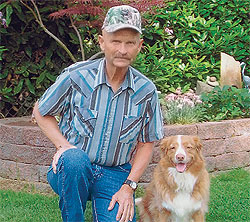 Glen White |
Glen White has been active in the toller breed for 22 years. In the past he has been active in all toller activities, but now concentrates on hunting waterfowl and upland gamebirds with his toller.
When he finds suitable conditions, he uses them for tolling ducks and geese. He does not currently breed tollers. His wife has a Schipperke that she uses for obedience trials, rally, and tracking.
Glen was first attracted to the breed by its smaller size.
"My first dog," he said, "was a Brittany and I liked his size, but his coat was too light for cold water retrieving. The first time I saw a toller, I knew they would fit my hunting style perfectly, and they have.
"I was also curious about the tolling aspect of the breed, which I've found practical and enjoyable under the right conditions."
Contact: Glen White, Tidewater Tollers; 2005 SE Nehalem St., Portland, OR 97202; tidewater@yahoo.com.